Evidence at a Glance
The current server spans scene, DAM, Jint, UI, simulation, inspection, and runtime interaction.
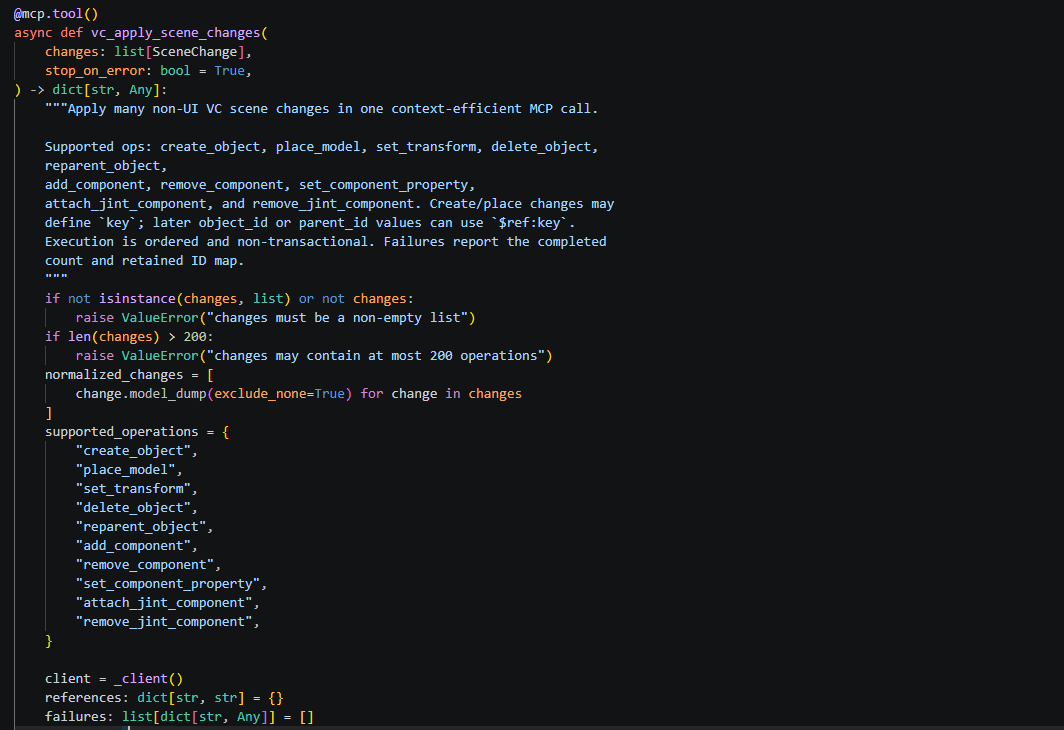
One ordered call can construct and wire a hierarchy with symbolic object references.
Streamable HTTP serves MCP while a private WebSocket carries VC operations into Unity.
Overview
VC MCP is the AI authoring and testing bridge for the Unity-based Virtual Campus Engine. Any MCP client, including ASE, can inspect scenes, create persistent content, work with Digital Asset Management, author Jint behavior, build runtime UI, start simulations, and observe the result through typed tools rather than mouse automation.
The packaged Python sidecar serves MCP over Streamable HTTP on port 8765, then translates each tool call into a versioned VC operation sent over a private loopback WebSocket to Unity on port 8766. Unity remains authoritative for scene, networking, persistence, DAM, and runtime state, and processes thread-affine work on its main thread or forwards it to the authoritative server path.
The current surface contains 56 MCP tools. Compact and paged reads protect model context, while intent-sized operations cover complete UI trees, ordered scene batches, script compilation, simulation control, screenshots, logs, visible UI, and bounded input for closed-loop testing.
The Challenge
A raw Unity edit can look correct while bypassing the VC Engine systems that make an object persistent, network-authoritative, reloadable, and safe to share. The bridge therefore cannot behave like a generic Unity remote control.
Agents also need to understand and verify large scenes without exhausting context. Each request crosses protocol and engine boundaries, and simulation testing must distinguish the editable VC scene from temporary runtime copies.
Key Engineering Decisions
Use VC-Native Persistence Paths
Models flow through DAM, behavior through Jint and Manage Scripts, UI through VC serialization, and scene work through authoritative SimulationScene operations rather than unsupported raw Unity shortcuts.
Separate Public and Private Transports
MCP clients receive a stable local HTTP endpoint; the engine-facing WebSocket remains private, versioned, and owned by the running VC client.
Budget Model Context Deliberately
Hierarchy, object, DAM, script, and log reads default to compact bounded results, with targeted full-detail queries only when the agent needs them.
Close the Author-Test-Observe Loop
Simulation controls, checkpoints, screenshots, runtime state, visible UI, logs, and bounded input let an agent verify behavior instead of stopping after code or scene mutation.
What I Owned
Results
Valuable Lessons
A domain-aware agent API must preserve the product's data and authority model; visually correct shortcuts can still corrupt the workflow underneath.
The most useful game-engine tools combine intent-sized mutations with observation, because authoring without verification is only half an agent loop.